
Ten Tips From Great Coaches to Making Great Leaders of Any Organization ( Tips 8-10) Balance – the Most Controversial One
Author: bestdayeverconsulting
CEO and Chief Consultant
Ten Tips From Great Coaches to Making Great Leaders of Any Organization ( Tips 8-10) Balance – the Most Controversial One
Tip 8-Appreciation- Great Leaders show their appreciation for all those that are involved in helping the program in any way! Whether it is the smallest jobs or those tasks thought to be the most important for success, Great Leaders are thankful and mindful that all the roles make a difference. Every individual that completes their part at their very best makes every job easier and makes the entire program better. This appreciation leads to all those within the organization trying to improve and keep their standards high. These parts of the program stay at the highest levels.
Great Leaders can also tell when some individuals are not bought in to what everyone else is bought into. After trying to motivate those failing to get on board, Great Leaders move on. They spend their time, energy and appreciation on those segments of the program that are ready to help the organization be its best.
Tip 9 – Major Changes or Small Details- Great Coaches know when they first take over an unsuccessful situation, to look at making their first major change is a change to make the biggest step toward putting the program into a successful spot. If taking over or carrying on in a successful situation, look to the details to take a step by step approach to making a good situation great. Change a bad situation by making the most influential major change first and in a good program look to the details (smaller changes) to move toward improving what is already good.
Tip 10- Great Leaders Have Balance in Their Lives- This will probably be the most controversial of all the tips and also the most important as having Balance in ones life is the only way to lead a Great Life! You can be a success without balance but you can not be a Great Leader! Contrary to what many preach, being single minded is not the best approach as by having Balance means your health, your family situation, your community situation all help you become a better leader to your team, business and organization.
Saying that you behave in a certain way and ignoring certain important aspects of what should be a portion of your life because you’re totally dedicated to your coaching, business or organization is a cop out. You can become a better coach, business leader, and organization president by putting your energy, creativity and passion into your health, family, community, and the program (the work) because the Balance makes each one better. Stop making excuses for missing important elements of your life because you feel that success in one area of the four components means ignoring other areas. Move toward Balance and find how Balance can bring a higher level of understanding toward becoming a Great Leader rather than a limited success. Becoming a better human being is a huge bonus! 
It is the rise of a Best Day with Balance!
Look after your Health, your family and your community. This Balance will make you a better leader on the job on the way to becoming a Great Leader!
Tips From Great Coaches That Will Make You a Better Leader (tips 4-7) second try?
Tips From Great Coaches That Will Make You a Better Leader (tips 4-7) second try?
Tips From Great Coaches That Will Make You a Better Leader (tips 4-7) second try?
Tips From Great Coaches That Will Make You a Better Leader (tips 4-7) second try?
This article caused a crash on my site so please give it another try.
These 4 tips that Great Coaches use to improve their programs will help Leaders to become better with their group. This is the middle four of 10 tips that will aid leaders whether you lead thousands or just a couple or you lead yourself. Like great coaches and leaders the tips are understandable and able to implement into your organization.
Tip 4- S-E-A- when bringing new ideas or personnel into your group the explanation should be SIMPLE so the role of the changes is easily understood. The change should make the operation and way to your targets more EFFICIENT so the change improves the path to what your program is striving to achieve. The final part of this tip is to make sure you can prove that the improvements are ACCOUNTABLE so they really do show that the new ideas and new people have improved the team. SEA makes us better.
Tip 5- Get Better Every Day- whether your group is coming off a championship or stuck in a losing streak, you must be striving to be better than you were yesterday. The ” if it ain’t broke don’t fix it” is not a good line if you are striving to reach your ceiling. While you’re satisfied where you are, your competition is changing to catch and pass where you were. GBE is a core of BDE.
Tip 6- Discipline leads to creativity and builds freedom- great leaders build discipline into every individual in the program they lead. Having consistency from everyone in effort, focus and understanding leads to creativity and freedom as the basics are taken care of because of the group’s overall discipline that runs throughout the organization. Discipline allows for creativity to be a factor as everyone is involved in doing what the team needs.
Tip 7 Find your own advisor/mentor/ truth teller- great coaches and leaders have someone in their inner circle that help them stay on track toward the target of their journey. These leaders have the confidence and belief in themselves to know that in order to improve themselves they need an advisor or consultant to be a pathfinder to stay on track toward the organization’s objective. To have a thinking partner to help as a GPS toward the leader’s and program’s goals makes a significant difference in achievement. This may seem like a shameless plug for BDE but having an advisor whose only goal is to keep a leader on track is the difference between success and not having success at the highest level. Have a thinking partner you can believe in and who believes in you!

Tips From Great Coaches to Business and Organization Leaders
Tips From Great Coaches to Business and Organization Leaders
This is the first three tips in what will be 10 tips for leaders of business and organizations taken from what great athletic team coaches do with their programs. If as a leader you can look at your organization as a team and get those in your program to look at themselves as part of a team, your group is going to be much more successful. These first 3 tips are helpful for all leaders and supervisors whether the group you head is thousands or 2. Maybe most important is all of us lead at least one person and those decisions might be the biggest ones for our individual successes.
Tip 1- Show up with a smile! Everyday you come into work show that you are excited to be there and passionate about what you are about to do! The best Coaches show up everyday like there is nowhere they would rather be. If you want the players to be enthusiastic about being there, you must be. Your team will feed off of your eagerness to be a part of this team and to be at training, this meeting or this game. For business leaders the people you guide will take their lead from the energy you bring into the workplace. Their excitement about the tasks ahead will be lifted by mirroring what they mirror from your smile. Show up with your smile because as a leader you want to be there facing the day with your team. You want your company workers to have a positive approach. It starts with your positivity about what we are going to accomplish today.
Tip 2- Set high standards and lay out a road map! If you want your team to achieve great accomplishments, goals and targets then the expectations and standards must be high. As their leader you must also fulfill these standards. Give your team the needed equipment and training both physically and mentally to reach the levels necessary to reach the goals and targets that have been set for individuals and groups. These standards are more meaningful when leaders encourage team members to be a part of setting the standards and figuring out the road map to achieve goals and targets. Teams, companies and organizations achieve greatly only when greatness is asked of them. So ask the questions but give them the material to find the answers that work!
Tip 3- Take stock of what your team has and build on the positives! Don’t waste time or energy on what your team does not have or what your competitors do have. Great leaders concentrate on how to make the most of the people and ingredients that are part of their program. Coaches and leaders are always trying to improve the situation of their program by training and enhancing their people and equipment. Top managers guide their team to make the most of what they have and face their challenges together. Your group makes progress when the team optimizes their components. It is a total negative to spend energy on what another team, business, or organization has to work for them. Get your team to be the best us!
Becoming a Better Coach- The Best Get Better. Part 4 of a Three Part Series
The Best Coaches and Leaders are always trying to make themselves better as coaches and people. In order to do so you have to find ways to add every day, every week, every season and every year, that is why this is part 4 of a three Part series. No matter how you did last year or last week, in order to truly move forward You have to progress. If you do the same thing in the same way the program does not move on whether you were champions or did not win at all. Yes, this is a mistake that even leaders of Champions make. For unsuccessful seasons you would think it would be obvious that you can improve some area but to many it is not. Always start with Yourself and get your other leaders to do the same. An atmosphere that allows introspection will allow growth. Here are a couple of ideas for head Coaches and assistant coaches.
Coach Whenever You Can– this is an area that has really helped me throughout my career and even more so now as a consultant. Whether you are watching a match in person or on television(streaming), coach one of the teams. I have had great discussions, arguments and talks with Pep, Unai, Jeremy, Jason, Oscar, Becky, Bobby, Jamie,Robbie and Jurgen (the list is much longer because if I am watching, I am coaching)when their teams were playing. What adjustments do you make? How are they playing? How are we playing? Who needs to go in or out? Make your comments and decisions in real time to someone there or write them down. The next time you’re coaching Man City or San Jose St you know what you told Pep or Simon to do. Everybody does it after the match but if you want to get better do it during the match. Sometimes they listen, sometimes they don’t. Sometimes they find a different way than the one you suggested. For assistants that are clamoring for your chance, this is a great way to be the head coach in a lot of matches but do it in real time and write it down or tell someone you’re watching the match with at the time you would do what needs doing. Assistants don’t do it for your own matches unless that is your assigned role for your match.
It is a really fun exercise when the coach or manager you are talking to listens and does what you have suggested and it turns into 3 points or salvages 1. Not as much fun when it doesn’t work but leads to further discussions if they did not act on your ideas. Thinking through your ideas and coming up with them during the match does help you become better when you are the decision maker and the BDE consultant is sharing ideas with you (whether he is there or not).
Start with One Idea to Improve- This suggestion is particularly aimed at assistants as it is important to feel vested and have ownership of some facet of your program although this is important for the head coach’s growth also. Take one area that you feel could be improved and learn everything about that area be it wing attacking play, fitness of midfield players, technical skills of a striker, or switching play by the defensive MF. Now make improving this area your extra task each day. Help this area and these players to get better while making the program better and also becoming a better coach yourself. If you really want a challenge learn more about an area that is a challenge to you and then you will have improved in a situation that made you uncomfortable in the past.
Becoming a Better Leader While Helping Others Lead Part 3 of a 3 Part Series
Becoming a Better Leader While Helping Others Lead Part 3 of a 3 Part Series
This is the third in the Best Day Ever Consulting series about becoming a better Coach (Leader) while working with others. The University of Central Arkansas soccer program and their head coach Ross Duncan was the first program to work together with BDE.
This is what Ross had to say about their program’s BDE experience, “BDE came into our program at a critical time. Frank was able to work with staff to identify many areas we could strengthen ourselves, both on and off the field. Frank has integrated himself into our program in a number of different roles. A mentor to me, a thinking partner for the staff, a role model for the players and , most importantly, a friend and confidante. There is no doubt that we would not have enjoyed our recent success without Frank.”
The first take away from the UCA experience is that as a leader you must be willing to seek out different routes to help your program find success. Ross was willing to do this, he was willing to search outside the norm and got his staff to accept BDE coming into the program. It took courage for Ross and for BDE to join in this venture together. This was not something US College soccer programs do but other sports and other soccer (football) teams around the world use -consultants, advisors and analysts all the time and with great effect. Lesson one from the Purple Bear experience is the courage to find all the resources you can goes a long way to improve your leadership abilities. It shows you are willing to do what you are asking everyone else in the organization to do, Grow!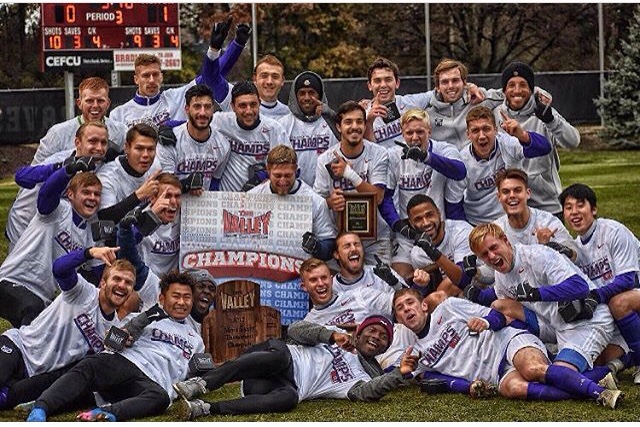
The second lesson for leaders is to make sure you are bringing quality to the program everyday. My first day with UCA none of the members of the team knew who I was nor did they care. As a leader I had to prove that I could add value to what was happening with the team. With this group the first area that I emphasized was belief in what we could accomplish together. We have built on this in every session, visit and podcast we have shared. The education for leaders is to make every day count! We expect the members of our team to bring their effort everyday, so as their leaders we have to give them a reason to get better today. We have to bring value in making today the Best Today it can be. I strive to earn the Purple Bears’ respect each and every session that I am with them. Bring Value!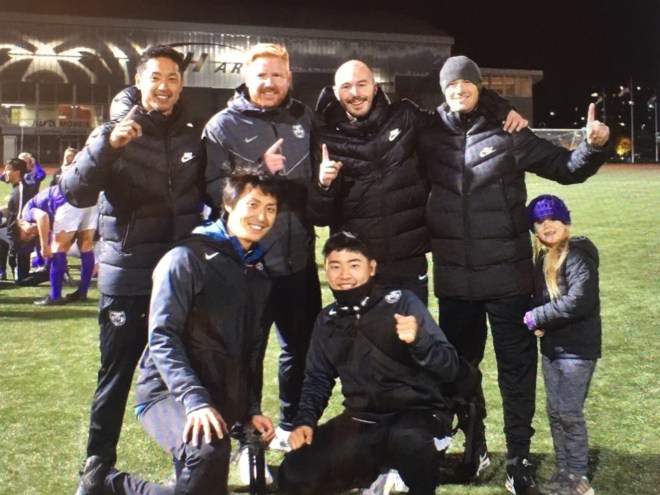
The third idea for leaders that working with the program at UCA has reinforced is to appreciate the positives. Try to see what someone else can do as a member of the group. So many times leaders in particular only look at what someone does not or cannot do. What are the positives of a player, a coach or a program? Look at your “haves” and build from there. You need to know where you are and where you want to go but also get in to appreciate the journey and your fellow travelers. There have been a lot of great experiences in being a part of The Purple Bear group. As a leader remember to acknowledge how lucky you are to be on this adventure with your group. Be excited for the next quest and enjoy those with you on the pilgrimage!
 Best Day Ever Soccer Consulting and Coaching